We use cookies in order to improve your browsing experience on sugarcane.org, not to collect personal information. By continuing to use the site, you agree that it is OK. Read about our privacy policy.
Climate change mitigation versus agricultural protectionism: the EU impasse?
Géraldine Kutas — posted 12/03/2016
What would you think if I told you that I want to have a leading role in climate change policy but that I restrict the access of renewable solutions to my market?
“You’re totally inconsistent” would be the natural answer. But this is exactly what the European Commission just did.
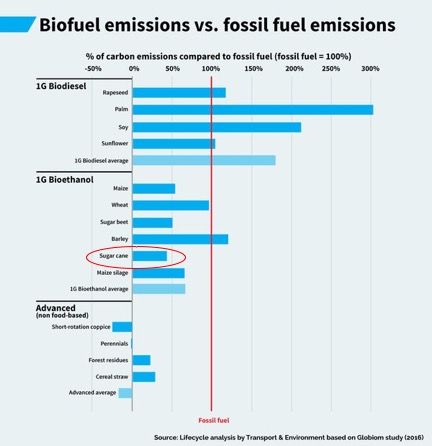
The EU has ambitious climate targets. The Commission is currently engaged in drafting its new renewable energy directive and is discussing its strategy post-2020 to decarbonize transport. The same institution, based on the conclusions of the so-called GLOBIOM study, acknowledges that sugarcane ethanol is the conventional biofuels with the highest greenhouse gas savings. Brazil is also producing second-generation ethanol based on sugarcane wastes and residues. Therefore, it would make sense for the EU to import sugarcane ethanol.
Wrong answer. Domestic vested interests prevailed over the EU public interest and the Commission decided to remove ethanol from the trade offer that was exchanged with Mercosur yesterday! Consequently, the EU will continue to import oil freely and to promote the consumption of inefficient biodiesel.
Read our position paper and you will get a sense of how disappointed and, to some extent, how frustrated I am.
The EU-Mercosur agreement would provide a unique opportunity to strengthen our collaboration in the sugar and ethanol sector – a sector in which a number of European companies (Shell, Tereos, BP, Louis Dreyfus among others) have already heavily invested in Brazil.
The sustainability and competitiveness of Brazilian sugar and ethanol would be a perfect complement to the EU production, increasing consumers’ welfare, boosting innovation in the bioeconomy while helping to preserve the environment.
It’s time to change the way we look at trade negotiations. They don’t take place in isolation of other policies. The Commission will have a second chance to include sizeable TRQs for sugar and ethanol in the next round of negotiations. Let’s hope it won’t be a missed opportunity!
Beyond the “conventional v/s advanced biofuels” dilemma: sustainable biofuels should win!
Géraldine Kutas — posted 07/03/2016
A few days ago, I was listening to the speech of Vice-President Šefčovič’s at a high-level event in Brussels on biofuels. This was shortly after the release of the Energy Security package, and so the Commission’s main angle was diversification of supplies, in addition to decarbonisation of transport obviously, given the upcoming Communication in June.
The Vice-President started by setting the scene: transport counts for a third of the EU energy consumption, one fourth of emissions, the instability on the international oil market, etc. The bulk of his intervention was then about the way advanced biofuels can help solve these issues. Needless to say, it was disappointing to hear no mention of sustainable first generation biofuels such as ethanol. This showed that once again the Commission had given up on all first generation biofuels regardless of their differences; and sugarcane ethanol falls victim to this black/white distinction in biofuels. As time goes by and only a few months remain until the publication of the decarbonisation of transport – and later on the review of the Renewable Energy Directive – it is frustrating to see the Commission perpetuate this simplistic approach.
But let’s try and be optimistic. Mr Šefčovič did also say that “all main alternative fuel options must be pursued”. We hope that sugarcane ethanol will be given a chance to prove what it can do.
In the meantime, a few days ago the Commission launched a tender for a study on the ILUC impact of biofuels. The purpose of this study will be to gather the ‘best available scientific ILUC research evidence’ able to influence ILUC modelling results.
I’m sure most of you sadly thought: “OMG…ILUC is back!” (me included!!!). However, this may eventually help the identification of low ILUC risk biofuels ahead of the elaboration of further legislation. This may be a chance for sugarcane ethanol to finally differentiate itself from other first generation biofuels in the upcoming proposals to decarbonize transport!
There are still opportunities out there to get recognition for the potential of ethanol in Europe’s transport system. We’ll keep following these developments as they unfold…read us to know more!
Reviewing the RED
Géraldine Kutas — posted 16/02/2016
The moment has come for the EU to review one of the main pieces of legislation that influenced the EU biofuels and transport policies in the last few years: the Renewable Energy Directive (RED). A public consultation was launched in November 2015 along with an Inception Impact Assessment, which highlighted the options that the Commission is considering for the review.
The legislation should be adapted to the new EU 27% target for renewables set up by the 2030 Climate and Energy strategy. No national targets were agreed. This means that the European Union as a whole has committed to increase the share of renewables in the energy consumption by 27% compared to 1990 levels, but that Member States will have to negotiate to split the cake.
27% is not such an ambitious target, but the most worrying element in my perspective is the lack of a transport target in the options considered by the Commission for the review. It seems therefore that as of 2020, there will no longer be what I consider the best way to promote renewables in transport. Overall, I am not sure we can draw any conclusions on a legislation which implementation was paralyzed for almost 4 years because of the highly polarized ILUC debate.
In any case, I submitted this morning, on behalf of UNICA, the response to the consultation and my three key messages are:
Liquid fuels will still dominate the market and they need to be decarbonized – By 2030, the share of liquid fuels in the European Union is still expected to account for 93% of all energy in transport. This means that the Commission needs to promote the use of cleaner liquid fuels if it wants to decarbonize transport – electricity alone cannot make it by 2030. Technologies to achieve this goal, such as sustainable biofuels, already exist and should be promoted along electrification.
Sustainable biofuels should be promoted – Mandatory targets, or obligation on fuels suppliers, remain the best way to incentivize RES in transport. In fact, liquid fuels fully depend on traditional fuels suppliers to distribute their products. The market power of these operators is too large for biofuels to compete. A mandatory target, or an obligation on fuels suppliers, is the only way to force them to place clean liquid fuels on the market. In addition, to promote the competitiveness of sustainable biofuels, they should be taxed in a fair way, that is on the basis of their energy content instead of energy volume.
Higher bioethanol blends will have a positive environmental and economic impact – Ethanol high blends, such as E20, E85 and ED 95 for heavy transportation, should be promoted, as alternative fuels. This technology, developed by European companies, already exists and has positive track record in Brazil. Sustainable ethanol high blends reduce emissions by 90%, they are scalable, they need minimal change in infrastructure and they are less costly than other solutions. In addition, they reduce local pollutants compared to diesel.
I hope these points are duly taken into consideration in the evaluation of the consultation responses and further on in the review process. I will certainly continue repeating that we need to be realistic about what the future may look like and give space to the more sustainable resources, without harming the overall competitiveness objective.
Making the right choices now
Géraldine Kutas — posted 15/02/2016
As I mentioned in the first blog of the year, 2016 is the ‘year of implementation’. The year we will have to put together the measures needed not only to achieve the 2030 Framework targets and Energy Union goals, but also the COP21 Agreement. Certainly a Herculean task for all parties involved! I wanted to reflect a bit more on this…
This means producing lots of papers, spending hundreds of hours thinking about what we have done right or wrong so far and – ultimately – finding a compromise that benefits everyone. Not just the EU institutions, but also consumers and the climate. COP21 gave a long-term general direction to everyone: we are officially transitioning towards a low-carbon future and need to phase out fossil fuels. How we will get there is the real question we have to address now.
Commissioner Cañete recently said at an event in Brussels that we have to admit the mistakes of the past and not be afraid of learning from them. I think everyone can agree to that statement. From energy efficiency to renewable, including bioenergy, the Commission is giving everyone the opportunity to contribute to a broad range of issues on which legislative proposals are expected. We have a number of things to say and questions to ask.
On the planned review of the Renewable Energy Directive for example, we were disappointed to see that no target was considered for renewables in transport. With liquid fuels retaining a crushing majority of the market share until 2030 and even beyond, the Commission needs to promote sustainable biofuels such as sugarcane ethanol to make sure transport can also contribute to reaching the overall 27% target.
Take also the Effort-Sharing Decision, which is about how Member States will reduce emissions in sectors which are not covered by the EU ETS (heating, transport, agriculture). The transport sector is likely to be drawn upon heavily given its potential for lower emissions. This is where higher ethanol blends can help by providing a relatively cheap and easy alternative. By increasing the share of ethanol in the fuels available at the pump (such as E20, E85, etc.), you can achieve significant GHG emission reductions immediately, without having to wait for people to embrace electric cars!
This is the sort of simple yet effective measures which seem to be overlooked at this stage. The communication on the decarbonisation of transport, expected in Q3 of this year, cannot ignore ethanol’s potential if it is to really mean something. Electrification will only get you so far; ethanol can help us take that extra step and tackle emissions in the remaining 90-something percent of liquid fuels on the market.
And that’s if we only look at CO₂ emissions. Sugarcane ethanol fits well in the circular economy agenda – residues from the production of sugarcane are also used to produce electricity.
Our level of ambition requires that we use the potential of all energy sources which are ready to contribute. I already said what I think about the RED review, I will elaborate more on the other initiatives as soon as there is more clarity on where the Commission is heading. In addition, I’m very curious to see what will come out from the consultation on bioenergy which was launched last week and to which UNICA is planning to respond.
One thing is certain: there won’t be a silver bullet for reducing emissions from transport, only a pragmatic approach will succeed. If the Commission is serious about learning from past mistakes in 2016, it should start making the right choices now.
Happy and ready for holidays after COP21
Géraldine Kutas — posted 20/12/2015
Remember our opinion piece on Euractiv on a scenario outcome for COP21? Even better!
For once the agreement was more ambitious that originally thought. We feel privileged to have witnessed from the inside a historic moment, one which produced a deal signed by 195 countries committing to limit, in a joint effort, global warming to 1.5°C by the end of the century. Sure, the content of the deal could have been better, and the INDCs submitted more ambitious, but what matters most is that for the first time in history, world leaders agreed on a single direction for the future.
It was an exciting and exhausting week for us. We manned a stand in the UNFCCC area to meet people from all around the world who had one goal: to share their solutions to help reach the ‘intended nationally determined contributions’ of countries and mitigate global warming. As you can imagine, we were there to talk about sugarcane products and the way they can help reduce emissions, whether in transport or power generation.
The UNFCCC area was a real hive that never really slept during the climate negotiations. We met over 300 people on our stand, among which many delegates, including those from Brazil. Many of them had a go at our sugarcane quiz, took pictures on the stand, asked for more information about sugarcane ethanol’s potential in the transport sector. We are very proud to plant 500 trees in Brazil as a result of our agreement with the Green Initiative!
This is our last post of the year, and we wanted to say thanks to all of you for reading our blog in 2015. We’re looking forward to coming back next year; when we will sit down to discuss how we turn this agreement into reality.
Our Authors
Eduardo LeãoExecutive Director
Emily ReesRepresentative for Europe
Leticia PhillipsRepresentative, North America
SIGN UP FOR EMAIL UPDATES
Join our email list and receive the latest news and updates from UNICA in your inbox.