We use cookies in order to improve your browsing experience on sugarcane.org, not to collect personal information. By continuing to use the site, you agree that it is OK. Read about our privacy policy.
Innovation: good for business, good for the environment!
Géraldine Kutas — posted 15/10/2015
Yesterday, President Dilma Rousseff visited the Sugarcane Technology Center (CTC), a world leading technology company gathering knowledge of the entire sugarcane value chain, and inaugurated its brand new biotechnology laboratory. Started as an association of sugarcane ethanol industries in 1969, the CTC was restructured in 2011 as a private company, and in 46 years it revolutionized the Brazilian sugarcane productivity and sustainability.
CTC focuses on cutting edge technologies working, for instance, on second-generation ethanol while improving the productivity of the sugarcane. The center has developed a new technology named “Flex Straw” to improve the collection and processing of sugarcane straw. This new technology generates additional 100,000 tons of sugarcane waste during the harvest, which, on average, could produce electricity to power a city of around 125,000 inhabitants. The sugarcane residue can be used to produce bioelectricity and second-generation ethanol, allowing companies to increased by 50% the production of ethanol out of the same volume of cane. Moreover, studies conducted by the CTC contributed to improve the quality of the sugarcane itself, which as a result is more resistant to insects and more tolerant to herbicides.
To say it with numbers, this all translates in circa USD 3 million per year of loss avoidance!
However, what makes innovation crucial in the development of any country is that its benefits are not constrained to one sector, it spillovers to the whole society. The innovation developed in CTC not only boosts the productivity of the sugarcane sector, but also puts Brazil in the forefront of the fight against climate change. That was the message the Brazilian President delivered during her visit to the CTC.
Speaking about the target to reduce Brazil’s GHG emissions by 43% by 2030 and the challenges to cut emissions in transport, President Rousseff stated: “One of the basis of this reduction is certainly in the fuel matrix, which happens to be the most difficult sector to cut GHG emissions in the world. But, In Brazil, we have an advantage: no car runs without ethanol in the country. We are committed to raise the contribution of ethanol in our fuel matrix from 30 to 50 billion liters.”
In the EU, the Commission has just adopted the Horizon 2020 work programme for 2016-2017, which foresees €10 million for the development of next generation biofuel technologies in each year of the programme. It is still early to say whether this will be enough to boost research and innovation in biofuels, considering the uncertainty regarding the 2030 Climate and Energy Package and the role biofuels will play in the long run. But chances are that, thanks to innovation, Brazil will overtake the EU in the development of clean fuels to decarbonize transport.
Brazil’s road to Paris
Géraldine Kutas — posted 28/09/2015
On Sunday, Brazil’s President Dilma Rousseff formally announced her country’s GHG emission reduction pledge at the United Nations Headquarters in New York. Looking back at some of her country’s achievements in the fight against climate change, Mrs. Rousseff said ambitious actions would still be undertaken.
And they are ambitious indeed! Brazil will reduce its greenhouses gas emissions of 37% by 2025 and 43% by 2030, compared to 2005 levels, Mrs. Rousseff declared. In perspective, that’s even more ambitious than the EU’s pledge of 40% in 2030 compared to 1990 levels!
For a leading developing economy to make such a commitment sends two messages.
The first is that yes, developing countries also need to do their part. As Mrs. Rousseff put it in her speech, COP21 is an opportunity to shape a “common response to the global challenge”, with “common but differentiated responsibilities”.
The second is that world leaders are finally confident that economic growth does not necessarily have to go in pair with dirty energy consumption. Clean energy sources are no longer a dream, or the luxury of rich countries. It’s now a fact: technology is ready; all we need is to use it and encourage its deployment wherever possible.
By 2030, said Mrs. Rousseff, Brazil will get 66% of its electricity from hydropower and 23% from other renewables, such as bioelectricity. It will also raise the share of renewables in its total energy mix to 45% (the role of renewables in Brazil have declined in percentage over the past years), with a 16% share for first and second-generation ethanol. Strong government objectives and steering will give the right signal for investors too, who will eventually make it happen and revamp the sugarcane sector.
It’s true the detailed breakdown of these numbers – needed to know how we’ll convert the targets into meaningful reality – remain to be known. This is something which will have to be discussed as a second step, by establishing a permanent dialogue between the government and stakeholders such as the Brazilian Coalition for Climate, Forest and Agriculture for instance.
But in the meantime, let’s celebrate Brazil’s ambitious pledge to the global effort against climate change, and the recognition that ethanol will be called to play a key role in it.
Talkin’ ‘bout my (second) generation
Géraldine Kutas — posted 16/09/2015
To kick the season off, I’ll be in Stockholm this week to talk about second generation biofuels, and in particular the outlook for ethanol produced in Brazilian bio-refineries. I thought it was a good opportunity to give you a short overview of what I’ll cover.
Renewables make up for around 40% of Brazil’s overall energy mix. That’s right, 40%. With a share of around 16% of this mix, sugarcane is the number one source of renewables in the country. Hydropower – the number one renewable in Europe – only comes second in Brazil. Today, sugarcane is used for two things mostly: sweetening your coffee and running cars on ethanol (mainly the juice), and producing bioelectricity (bagasse).
But 2G ethanol opens new opportunities: it reduces GHG emissions by more than 90% compared to gasoline, it increases ethanol production by 50% and it doesn’t compete with food crops as it’s based on crop waste. Indeed, by using the sugarcane residues, second-generation ethanol refining maximizes resources efficiency.
This is what one of Brazil’s biggest energy companies, Raizen, does at its new 2G plant. By using enzymes to transform the cellulose of sugarcane residues (bagasse and straw), the plant produces 42 million liters of second-generation ethanol the cost of which are expected to fall below those of 1GE in the next five years. Interestingly enough, the plant is co-located to an 80-years old sugar and 1G ethanol production facility.
The GranBio plant in Brazil, is another good example of what sugarcane can bring to the energy sector. Aside from the 82 million liters of bioethanol it can produce annually, the plant also co-generates electricity and heat with bagasse and lignin. As such, it produces enough power for 300,000 inhabitants. Not bad for bioelectricity, right?
With the right harvesting and processing techniques, these companies show that second-generation biofuels bring their own set of opportunities, not least of all the ability to literally double Brazil’s biofuels production without increasing planted surfaces, by using waste as feedstock. Also, they’re available all-year long, and they’re almost carbon-neutral.
At a time when energy efficiency, decarbonisation, and waste reuse are topping the environmental agenda, the reality of proven solutions such as bioethanol and bioelectricity must be acknowledged and supported with the right public policies in order to be able to release their full potential.
That’s the story I’ll tell the folks in Stockholm, in a nutshell. Stay tuned for more!
Let’s be smart(er)!
Géraldine Kutas — posted 03/09/2015
Considering the traffic these days in Brussels, it really looks like EU institutions are back to school, and so are we! Let’s have a look at what’s coming our way to give you a little taste of what we’ll be talking about over the next few months.
And talking about traffic and transport, the months ahead will be rich of news in the sector.
COP21 is approaching fast (less than 100 days to go now) and the pressure is rising for World leaders to work towards and reach an ambitious and binding climate deal in Paris. The European Commission has committed to reducing its GHG emissions by 40% in 2030, and given the extent of the challenge, all sectors will have to make the necessary efforts to achieve this objective. Indeed, according to the latest Commission reports, the pace of renewables’ penetration in the transport sector has been slow so far (only 5.7% in 2014). All eyes have now turned to the post-2020 framework, around which most of the EU transport debate will revolve in the coming months.
The Commission is getting ready and is scheduled to release a Communication on the Decarbonisation of Transport in the first half of 2016. The question is: what is this strategy going to look like? A few weeks ago, the Commission closed a consultation on the review of the 2011 White Paper on Transport. The verdict? It’s something that UNICA has been advocating for long time: intermediate targets are needed if the EU is serious about achieving its long-term transport decarbonisation objectives. So most of the respondents also said!
The role of electric cars will be important, there’s no one denying that. But in 2030, 90% of EU vehicles will still be running on fuel, according to a recent E4Tech report. That’s why we’ll also need lighter and more efficient cars. The Commission has said it is looking at stricter emission standards for road vehicles. But and perhaps most importantly, we’ll need cars using cleaner fuels. Smarter fuels. And that’s where ethanol can make a difference.
Too often biofuels are seen as a unitary group of transport fuels, regardless of their differences. Smart biofuels are those using production processes, which are responsible and sustainable. Not only do they help decarbonize transport, they can also contribute to a thriving economy. Don’t take our word for it, take that of the Director General of the Food & Agriculture Organization (FAO)! Brazilian sugarcane ethanol does precisely that. It reduces GHG emissions by 90% compared to traditional fossil fuels, it is mostly grown on degraded pastureland, hence not competing with food crops, and it’s creating good jobs.
But that’s not all. You’ve probably heard of ‘Smart Cities’, the more efficient, sustainable cities of the future. Sugarcane ethanol can also help make these cities a reality through waste-to-energy processes. One example: bagasse, the fiber residues resulting from sugarcane processing, can and has been used to generate bioelectricity in Brazil, where this has helped reduce emissions of more than 300 million tons of CO₂ in the atmosphere since 2003. Adding to its lower GHG emissions and air quality advantages over traditional fuels, smart biofuels will need to play a role in urban transportation if we are to build a truly sustainable transport system for EU citizens.
The choice is simple; either we stick with the old policies, which fail to make real progress, or we adopt new, smarter ones, which include a role for all greener transport solutions, including ethanol. We still have a few months to help the EU do that, so let’s get back to work!
In the past UNICA has supported EPA’s decisions implementing the RFS and as a result of Brazil’s long-term commitment to sugarcane ethanol, Brazilian sugarcane ethanol producers have supplied the majority of the U.S.’ undifferentiated advanced biofuels since EPA began implementing the RFS.
But now, UNICA urges EPA to reconsider its proposal to reduce required volumes of advanced biofuels and total renewable fuels for 2015, 2016, and possibly beyond. UNICA has three issues with EPA’s proposed significant reductions of the statutory volume requirements:
– Lowering the statutory volumes by the specified amounts is not supported by the statue nor necessary, at least in 2016 when Brazil could export higher volumes of advanced biofuels under the right market conditions. We believe EPA understates the capacity and ability of Brazilian imports to assist in implementation.
– EPA lacks proper rationale to lower the advanced biofuels and total renewable fuels volumes in the manner and amount it proposes.
– EPA’s proposed reductions do not support Congressional intent on the RFS jeopardize progress toward increased use of low-emission fuels, nor do they support President Obama’s Climate Action Plan or the recently announced bilateral climate agreement between the U.S. and Brazil.
Brazilian Investments Mean More Supply Than EPA Estimates
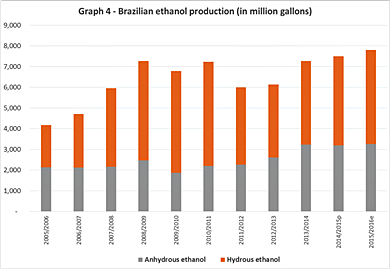
Brazil’s sugarcane ethanol producers are investing over $3.5 billion through 2017 in new ethanol pipelines, inland waterways, and port facilities. Sugarcane ethanol production is continuing to rise and preliminary figures for 2015-2016 estimated 7.8 billion gallons produced.
About 65 percent of Brazil’s vehicle fleet is composed of flexible fuel vehicles, which can run on E25 instead of E100, allowing hydrous ethanol production to be dehydrated and fulfill export contracts. This flexible hydrous ethanol market means export commitments would not suffer even if faced with a negative harvest season and thus, lower volumes of sugarcane ethanol.
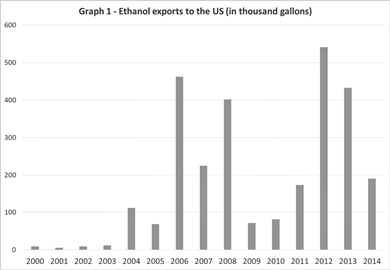
EPA’s proposal opines Brazil cannot supply the 3-4.7 billion gallons in advanced biofuels it calculates would be required between 2015-2016 under the RFS statutory volumes, and Brazil would be unlikely to reach such figures when its highest level of U.S. exports was 680 million gallons in 2006. But in fact, UNICA forecasts under the right market conditions, Brazil can have the capacity to produce an estimated 2 billion gallons of sugarcane ethanol for export to America in 2016, according to installed capacity figures from Brazil’s National Agency of Petroleum, Natural Gas, and Biofuels (ANP).
EPA’s At An RFS Crossroads – Avoid The Wrong Route
Congress’ intent in establishing the RFS, EPA’s action to date, President Obama’s Clean Power Plan goals, and the U.S.-Brazil climate accord show international leadership and commitment to ensuring emissions reductions. But EPA’s Proposed Rule threatens the integrity of these commitments and UNICA urges EPA to avoid action reducing advanced biofuel imports or prioritizing less-efficient fuels over sugarcane ethanol, certified as 90 percent cleaner than conventional gasoline.
If EPA continues to assert it has authority and reasonable justification to reduce statutory volumes for biofuels, UNICA urges EPA to:
– Lower statutory volumes only to the absolute minimum. UNICA supports efforts to increase the annual volumes for these fuels and believes they should not be lowered any further in 2015, 2016 or beyond.
– Avoid reducing volume requirements for advanced biofuels or total renewable fuels below 20 percent in 2015 and 2016 in view of statutory reset provisions.
– Consider changing Equivalence Values (“EVs”) for low-lifecycle emission fuels like sugarcane ethanol to spur further growth in advanced biofuels and help obligated parties meet statutory volume requirements.
UNICA understands EPA finds itself at an RFS crossroads, but EPA needn’t rewrite the program’s goals before they can be achieved, and should not unfairly affect Brazilian exports. EPA can stimulate the market for advanced biofuels by keeping as close to the statutory volume requirements as possible and encouraging importation and production of low-lifecycle emissions renewable fuels, rather than discouraging them by lowering demand.
Our Authors
Eduardo LeãoExecutive Director
Emily ReesRepresentative for Europe
Leticia PhillipsRepresentative, North America
SIGN UP FOR EMAIL UPDATES
Join our email list and receive the latest news and updates from UNICA in your inbox.