We use cookies in order to improve your browsing experience on sugarcane.org, not to collect personal information. By continuing to use the site, you agree that it is OK. Read about our privacy policy.
Fancy a visit to Brazil? Brazil comes to you… Come and see us at the Brazilian Pavillon, EXPO Milano 2015
Géraldine Kutas — posted 12/05/2015
This year’s theme of the Universal Exposition EXPO Milano 2015 “Feeding the planet. Energy for life” couldn’t be more spot on for us!
I’m very excited to present Brazil’s success story with renewable fuels and to organise a conference on “Producing food and energy for a healthier planet: the case of the Brazilian Sugarcane Ethanol”, on Tuesday 2 June in the Brazilian Pavillon, Milan of course!
As I mentioned a few times already in my blogs, Brazilian sugarcane industry typically supplies both food and energy, with a minimal use of land. Only 0.5% of Brazil’s territory is used for bioethanol, with which Brazil managed to replace 40% of gasoline.
We’ll have a number of speakers , experts in sugarcane, including former Minister José Goldemberg, Sven Sielhorst from Solidaridad and Simon Usher Chief Executive Officer at Bonsucro, ready to walk you through the Brazilian experience and we hope this may serve as an inspiration for Europe, which is struggling to make a good use of biofuels.
More information on the event are available here! Come and see us in Milan…as an anticipation I can already tell you that the event will be followed by a cocktail with Brazilian food and drinks, where Chef Diego Lozano will talk about the history of Brazilian pastries to interested participants!!!
The Good, the Bad & The Ugly… about ILUC
Géraldine Kutas — posted 29/04/2015
Members of the European Parliament finally endorsed the COREPER text on ILUC yesterday morning in plenary. After the disappointment of not winning concessions from Member States on any of their main points, MEPs have – against the will of many – voted in favour of the Council ILUC text. Final rubber stamp (for real this time!) should be given by Member States at the next Energy Council on 8 June.
In the meantime, in case you are confused on the outcome of almost three years of negotiations, here below you can find a summary (I couldn’t help thinking about this movie, which also happened to be quoted by Mr Torvalds during yesterday’s debate!)
“The Good”
– Little consolation that the final cap agreed is set at 7%. My comment is: better than nothing! We have always criticized such a black and white approach, but we don’t want to be too negative and at least a higher cap than the 5% proposed by the Commission will allow a little share of bioethanol to remain in the EU biofuels market.
“The Bad”
– The 0.5% non-binding target for advanced biofuels. With no incentives for advanced biofuels, their ability to participate to the 3% left of the 10% RED target is even more in doubt…
“The Ugly”
– …and, of course, the exclusion from the deal of the 6.5% sub-target for bioethanol. More sustainable biofuels will therefore not be incentivized in Europe and Member States will not move towards an E10 blend. A real disappointment for bioethanol, considering that biodiesel will cover most of the 7% cap.
It’s time to turn the ‘ILUC page’ and look beyond 2020. Policymakers need to start thinking already about the longer term and set up a credible framework for the post-2020. Low-ILUC biofuels should be promoted and sugarcane bioethanol is one of those.
We see two important milestones in particular: the revision of the Renewable Energy Directive in 2016/2017 and the wider discussions around the decarbonisation of transport. In both cases, we will be there to put sustainable biofuels at center stage.
California LCFS Re-Adoption Workshop Shows Sugarcane Biofuel Benefits
Leticia Phillips — posted 07/04/2015
Last Friday, the California Air Resources Board (CARB) held a workshop on the Low Carbon Fuel Standard (LCFS) re-adoption process. Updates to CARB’s indirect land-use change (ILUC) modeling and carbon intensity lifecycle analysis reinforce a key fact – sugarcane ethanol is the most environmentally friendly biofuel supplying today’s market.
CARB’s revision of indirect land-use change (ILUC) modeling resulted in reduced penalties for Brazilian sugarcane ethanol and the lowest overall number in the LCFS, confirming it as the lowest-carbon biofuel available at commercial scale today.
This positive result is due to the sugarcane industry’s innovative sustainability efforts including reducing deforestation, promoting a double-crop system in production, and expanding mechanized harvesting instead of pre-harvesting burning techniques.
However, sugarcane ethanol’s environmental benefits in the LCFS would be even more significant if CARB included the emissions benefits of electricity cogeneration in sugarcane mills using leftover plant material, which displaces fossil fuel power generation.
UNICA was disappointed CARB has chosen to apply a U.S.-style average electricity mix to Brazil rather than crediting sugarcane biofuel producers for this marginal displacement of fossil energy. The average electricity mix approach may make sense for the U.S., but it does not realistically calculate the low-carbon benefits of bioenergy in sugarcane production, and we urge CARB to reconsider this decision.
LCFS re-adoption will have a major impact on America’s single largest transportation fuels market, but will also reverberate in states now launching their own LCFS policies. California has always led America in clean fuels policy, and CARB’s approach will once again stand as a national model for emulation – let’s ensure policymakers get biofuels policy right.
EU still debates E10, while Brazil moves to a 27% blend
Géraldine Kutas — posted 16/03/2015
Working for Brazilian interests, you may say my judgment is biased, but I just can’t help praising the decision taken by the Brazilian government to increase, today, the ethanol blend in gasoline to 27%. This move is expected to have a positive impact on the biofuels industry and will no doubt have a positive impact on the environment.
A question came straight to my mind: Is the EU not simply lagging behind? As Brazil moves to 27%, is it not incredibly ironic to see Europeans getting cold feet about moving to a 6.5% content of ethanol (in energy) in petrol?
I mean, the EU wants to be at the forefront in the fight against climate change and you’d expect sustainable fuels to be promoted over less sustainable ones. However, it seems the EU is not even ready to generalise the use of E10! In the current debate around the 6.5% sub-target for bioethanol in petrol, some argue it would go against a level playing field between biodiesel and bioethanol – despite the superior GHG savings of the latter. Another reason invoked is technical compatibility with the current fleet. In the meantime, the United States widely use E10 and Brazil is even allowing higher blends.
You might ask yourselves: why the EU is struggling with this?
ENVI MEPs barely managed to pass a sub-target at 6.5% in their second reading position and Member States don’t seem overly enthusiastic.
The reality is that only a few people actually understand the meaning of ‘that 6.5%’. I would like to explain it here and respond to the main concerns raised by MEPs and Member States.
A 6.5% of renewable energy (in energy) in petrol corresponds to an ethanol blend of 9.5% in volume (E9.5). Although the European Commission declared in 2012 that E10 should be the main petrol fuel used in all the Member States by 2013, only 3 Member States (France, Germany and Finland) are currently selling this blend in fuel stations.
The good news is that there are no technical barriers preventing widespread use of E10 across Europe, as 90% of all cars produced after the year 2000 can run on E10. The only element needed is the political will to incentivise bioethanol usage among European consumers who are otherwise attracted by diesel, currently benefiting from lower taxation compared to gasoline.
Another essential question needs to be addressed at this point: why does a level playing field between biodiesel and bioethanol not make much sense?
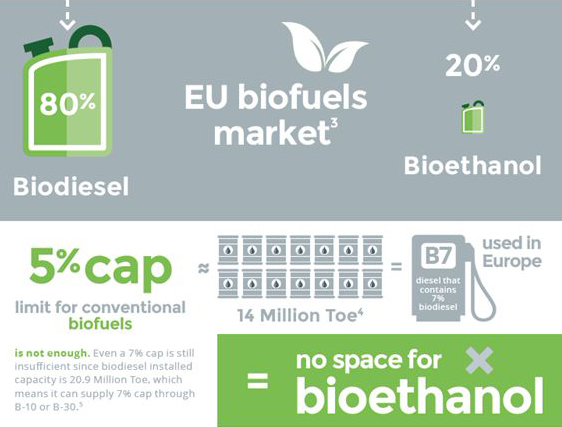
Because biodiesel is already the preferred option in Europe and, with a cap on traditional biofuels, Member States will meet their target for conventional biofuels (at whichever level it’s eventually set: 5, 6 or 7%) just by using biodiesel.
What would be the consequence? Bioethanol would be out of the market, despite its sustainability!
It’s absolutely critical to understand the consequences of a cap on traditional biofuels and the subsequent necessity for a specific sub-target for bioethanol. In addition, if the EU market stays locked with E5, there will be no space for advanced ethanol as there is currently enough conventional production to supply this blend.
We, at UNICA, tried to make it simple and understandable for non-experts in this infographic. I hope this helps!
It’s now up to Member States to show commitment to the reduction of transport emissions
Géraldine Kutas — posted 24/02/2015
Today, the European Parliament’s Environment committee adopted a second reading position on the ILUC dossier, and I’d like to congratulate MEPs for many of the points they expressed through their vote.
First, they signed off on a 6.5% target for energy from renewable sources in petrol by 2020. At UNICA, we believe this particular amendment was critical to the development of a more balanced biofuel policy in Europe. Today, MEPs agreed on a 6% cap on conventional biofuels. This cap could be entirely met by biodiesel, leaving no room for bioethanol (please see our new infographics here on why this would be the case) 6.5% sub-target for RES in petrol.
If we want to be serious about reducing emissions from petrol, we need to be able to blend it with bioethanol, a fuel guaranteeing significant emission savings, even when ILUC is taken into consideration. The 6.5% target provides certainty for bioethanol and will help the EU reduce its transport emissions.
Second, we are satisfied with the 1,25% sub-target for advanced biofuels, assorted with multiple counting. We believe it is a realistic ambition and a good signal sent to investors. Developing advanced biofuels requires considerable R&D efforts. For projects to reach commercial scale – a great challenge for some advanced biofuels – the regulatory framework needs to be crystal-clear.
Finally, I am also particularly glad to see that ENVI MEPs agreed to consider a longer timeframe for biofuel policy beyond 2020. We hope this will break the ‘code of silence’ around biofuels for the post-2020 period that has prevailed in the Commission over recent months.
As the Parliament will now engage in trialogues with Member States, we urge the rapporteur Nils Torvalds to carry these three points forward, especially the 6.5% target for renewable energy in petrol.
I’m aware that there will be limited flexibility amongst Member States to deviate from the Common Position adopted in first reading. The Council openly stated that the target for renewable energy in petrol was seen as unnecessary (Council Statement accompanying the first reading position) as it would not directly tackle ILUC. However, I strongly believe that the one way of tackling ILUC is to incentivise the consumption of low-ILUC biofuels such as bioethanol and even more, Brazilian sugarcane bioethanol. Sugarcane bioethanol brings emission savings of 55.8%, even when the ILUC impact is taken into account.
My last word will be for Member States: if you are serious about reducing transport emissions, use every opportunity at hand, including the wider use of bioethanol to reduce emissions from petrol!
Our Authors
Eduardo LeãoExecutive Director
Emily ReesRepresentative for Europe
Leticia PhillipsRepresentative, North America
SIGN UP FOR EMAIL UPDATES
Join our email list and receive the latest news and updates from UNICA in your inbox.