We use cookies in order to improve your browsing experience on sugarcane.org, not to collect personal information. By continuing to use the site, you agree that it is OK. Read about our privacy policy.
New Ecofys study guts “land grabbing” charges against EU biofuel policy
Géraldine Kutas — posted 03/10/2013
Ecofys, a well-respected Dutch consultancy, is out with a new study that effectively eviscerates the association of biofuels with “land grabbing,” that favorite charged-phrase NGOs pedal that industry is in the business of pushing locals off their land.
The meaty conclusion from Ecofys: “At best, only 0.5% of all deals in the Land Matrix concern land grabs for EU biofuels.”
Bear in mind, Ecofys is an environmentally minded consultancy, if you will, that does studies for the European Union, industry, and even NGOs. This particular study was commissioned by ePure, the European Ethanol Producers.
The Ecofys study says that biofuels used in the EU market basically do not come from feedstocks produced from “grabbed” lands, undermining among NGO arguments against EU biofuel policy is that biofuels “take land away” from food production and rural communities.
The study cross checked a number of entries in the Land Matrix of the International Land Coalition. Although the best informed global database on land deals, the Land Matrix “is based on reports from the media and NGOs which both often overestimate scale,” says Ecofys.
Nonetheless, the matrix had a total of 617 deals in its system, covering around 38 million hectares, as of March 2013.
This extract lays out the message Ecofys conveys with this study: “Of these 617 deals, we assessed 66 deals, which sum up to 25.8 Mha, or 67% of the total acreage in the database. This includes the 50 largest deals around the world, as well as the 5 largest deals given per sub-region in the Land Matrix. We checked these deals by collecting all possible and available information about these deals on the internet and sometimes from private investigation, by checking information with networks within the respective countries.”
What does Ecofys have to say about NGOs wild claims? “Action Aid claims that ‘it is estimated that biofuels have been involved in at least 50 million hectares being grabbed from rural communities.’ This is 28 times (!) our findings of about 1.8 Mha. The total extent of land deals that can maximally be connected to the EU biofuels policy in past and until 2020 is probably another ten times smaller.” Here is the latest report on social impact of EU biofuel policy by Action Aid.
Finally, the study argues that the voluntary schemes introduced in the framework of the so called RED (EU Renewable Energy Directive) actually helped the development of better regulation in third countries on social and economic aspects of biofuels production. A very successful example is Bonsucro, The Better Sugarcane Initiative, to which UNICA is member and which certifies — according to EU standards — 29 Brazilian mills, covering 6.5% of the total Brazilian sugarcane area and more than 2 billion liters of sugarcane ethanol.
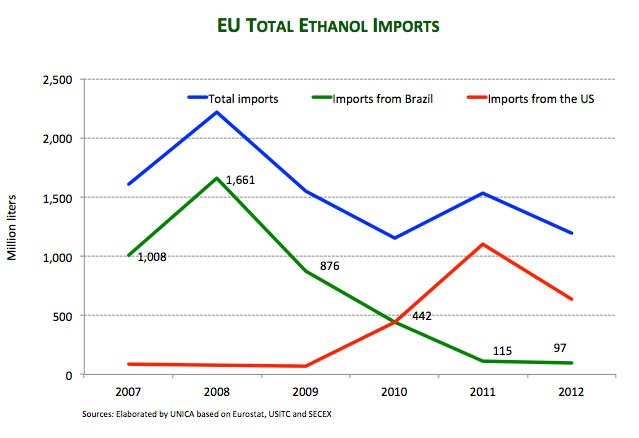
The Ecofys study looks at the effect of the EU policy promoting biofuels, hence starting from 2009. It is worth to notice that from 2008, ethanol exports from Brazil to the EU considerably decreased as the graph here below shows (from 1,661.4 million liters in 2008 to 97.21 million liters in 2012); therefore there is clearly no connection between land “grabbing” and increasing demand and exports for biofuels to EU in the case of Brazil.
For more, find the Ecofys report here. Pangea, which represents pan-African bio-energy interests, produced a short take on the report.
Looking forward to more reactions to this report.
E&ETV Explores Sugarcane Biofuels and the Future of the RFS
Leticia Phillips — posted 23/09/2013
With Labor Day behind us, Washington D.C. has officially ended summer vacation and gotten back to work. Brazil’s sugarcane ethanol producers are no exception, and we’ve renewed our efforts making the case for advanced biofuels.
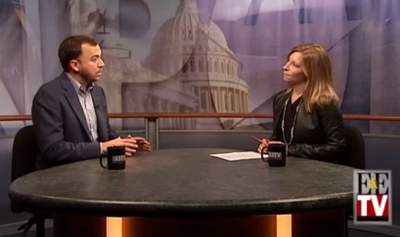
To kick things off this week, Joel Velasco – senior vice president of California-based renewable fuels company Amyris and board advisor to the Brazilian Sugarcane Industry Association (UNICA) – sat down for an interview on E&ETV, an influential webcast on Capitol Hill featuring energy and environmental policy leaders.
Joel offers unique insights into the advanced biofuels industry because (besides his advisory role with UNICA) he is also senior vice president of California-based renewable fuels company Amyris and a board member of the Advanced Biofuels Association. Joel shared his perspective on several key topics:
The state of play for renewable fuels in the U.S. The Environmental Protection Agency (EPA) may have officially lowered the 2013 target for cellulosic ethanol and announced it will probably reduce volumes for other advanced biofuels starting in 2014, but that doesn’t mean an end to sugarcane ethanol’s modest but important role supplying America with clean renewable fuel. According to Velasco:
“What EPA did during the summer break was to basically finalize the rule they had already proposed earlier this year that said, we don’t have the cellulosic fuels but we do have other advanced fuels – let’s continue going on that path.”
“We’re really talking about an increase from 2013 to 2014, as the law was written, of about a billion gallons. Most of that was going to be cellulosic biofuels – those we know are probably not going to be available for 2014. The big question is how much of that cellulosic they’re (EPA) going to waive into the other advanced pools, and how much of that cellulosic is just going to disappear or is not going to be required.”
Congress’ next steps on the Renewable Fuel Standard (RFS). While EPA sets the annual targets and administers the program, Congress has also been working on the future of renewable fuels policy, starting with the House Energy and Commerce Committee’s white paper process. Joel opined:
“The committee should be commended for having this white paper process…I really think this was a unique way to get stakeholder input. It allowed everybody who had a stake in the game to actually provide input on a number of issues. I think the committee now has all the views that they need to look at.”
Obviously, if they get into this, we’re getting into a situation of then opening the Clean Air Act and making amendments to it…Once you start messing with the Clean Air Act all kinds of folks are going to get involved, and I just don’t think the legislative calendar will allow for some sort of (legislative) reform.“
Expanding Brazil-U.S. biofuels trade. Global ethanol trade is creating economic and environmental benefits for both Brazil and the U.S. That growing relationship is anchored by fair trade and the RFS, and may expand during the first-ever biofuels trade mission coming up between the two countries. Velasco explained:
“Brazil and the United States are the world’s two largest producers of biofuel…And I think both countries, whether it’s President Obama here or President Rousseff in Brazil are committed to pursuing that deep relationship. We have a lot to celebrate – neither country has barriers for their biofuels, the ethanol tariff is gone here, Brazil has maintained a zero tariff there, and the subsidies are pretty much ended. So now it’s time to talk about what markets can we build beyond our two countries, and how do we strengthen the relationship?”
“The Advanced Biofuel Association, Renewable Fuel Association, and Unica are going to bring together companies in Brazil (for American biofuels companies)…And we will see what are the other options we have not just in Brazil or the U.S., but around the world. I think this is a great step in the right direction, and it’s proof that the RFS is working because these industries are being formed and we’re looking at how we can actually deepen the integration between these two economies.”
Joel’s interview comes at an important time for the advanced biofuels industry, both here and abroad. Sugarcane ethanol is a key component to America’s renewable fuel goals and Brazil is committed to continue growing as a trusted trade partner with the U.S. As debate over the future of the RFS continues, we’ll continue to highlight the importance of maintaining access to clean renewable biofuels.
Clearing up a few myths about Brazilian biofuels trade
Leticia Phillips — posted 18/09/2013
The late U.S. Senator Daniel Patrick Moynihan is often credited for quipping that everyone is entitled to their own opinions, but not to their own facts.
Fresh export data from Brazil reminded me of that saying because it will come as an unwelcome reality check for naysayers of sugarcane ethanol. Let’s turn to the facts to debunk two leading myths circulating around Washington, D.C. about Brazilian sugarcane ethanol.
Myth #1: Brazil can’t supply sufficient sugarcane ethanol to meet America’s needs.
Reality: Brazilian sugarcane ethanol is on track to not only meet, but could exceed the amount regulators projected necessary to comply with theRenewable Fuels Standard (RFS) 2013 targets for advanced biofuels.
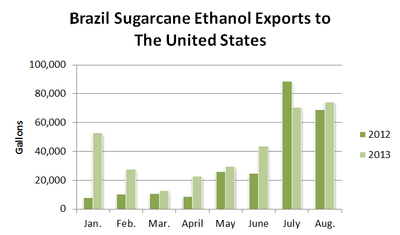
The U.S. Environmental Protection Agency (EPA) has forecast that the U.S. will need almost 600 million gallons of sugarcane ethanol to meet RFS requirements this year. As of August 31, Brazil’s sugarcane ethanol producers have shipped about 330 million gallons to U.S. markets, compared to 267 million gallons during the same period in 2012. (For those keeping track of the imports and RINs after reading Sunday’s New York Times, just look at EPA’s data online to see that over 250 million gallons worth of RINs have been generated from imported advanced biofuels like sugarcane ethanol.)
Some simple arithmetic shows Brazil’s exports year-to-date are only slightly more than half what’s needed for the year. Bad news, right? With eight months down and just four to go, rumors are circulating that sugarcane ethanol imports won’t supply the necessary gallons.
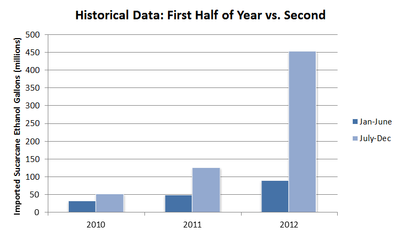
But those naysayers forget Brazil’s sugarcane harvest starts in April, meaning ethanol exports tend to start slow in the first half of each year before hitting high gear in the second half. In fact, American imports of sugarcane ethanol during the second half of each year have historically been three to five times higher than imports in the first half of each year.
Compare the first half of 2013 with other historical data[i] and it’s clear that Brazil is easily on target to meet EPA’s expectations:
But don’t just take my word for it. In the agency’s final 2013 RFS rule, EPA notes that sugarcane ethanol imports this year have increased by 110% to 147% compared to 2012. EPA then observes: “[t]his increase, combined with the fact that the majority of Brazilian ethanol exports to the United States have historically occurred in the second half of the calendar year, suggests that Brazilian ethanol exports to the U.S. are on a trajectory that would readily enable Brazil to supply 580 million gallons to the U.S. in 2013.”
Of course, the real driver of imports is U.S. demand. And here we have to again tell the RFS naysayers to check their facts. Despite the doom and gloom of some special interests, the biofuels industry has delivered the gallons. Not just conventional biofuels, like corn ethanol, but also the advanced biofuels, from biodiesel to sugarcane ethanol. In fact, thanks to robust growth in advanced biofuel production in the past few months, the U.S. may not demand the level of imports that EPA expected earlier this year. That’s more proof that the RFS is working.
Myth #2: The “ethanol shuffle” that sends corn ethanol to Brazil and sugarcane ethanol to the U.S. doesn’t help the economy or environment of either country.
Reality: The 2011 shuffle was a one-time event, and Brazil is a net-exporter of biofuels.
Brazil is committed to helping America meet its renewable fuels goals, and production has expanded over time to meet rising U.S. demand. Ethanol production so far in 2013 is up 7 percent compared to first-half August 2012, and 8 percent compared to second-half August 2012.
Growing sugarcane ethanol production and export levels also put to rest any fears of another “ethanol shuffle” between Brazil and the U.S. This term refers to the one-year anomaly experienced in 2011 when America exported a comparable amount of corn ethanol to Brazil as the volume of sugarcane ethanol imported from Brazil.
As of the end of August, Brazil had only imported 31 million gallons of corn ethanol from America – which is less than 10% of the sugarcane ethanol Brazil has exported to the U.S. during the comparable period. Unfortunately for some critics, the music’s stopped on the ethanol shuffle, and the phenomenon is clearly not happening again in 2013.
Reality: A Committed Partnership On Renewable Fuels
Brazil’s sugarcane producers look forward to working with EPA to find the right advanced biofuels requirements under the RFS for 2014 and beyond, and stand ready to help America meet its growing goals for low-emission transportation options.
I think that even by Senator Moynihan’s high standards, we might all agree these observations are facts worth keeping in mind the next time an unfounded opinion gets in the way of reality.
[i] All data courtesy of the Brazilian Ministry of Trade & Development’s Secretary of Foreign Trade online database.
European Parliament Vote on Biofuels: the EU continues Search for a Resolution
Géraldine Kutas — posted 12/09/2013
A mixed bag from Wednesday’s full European Parliament vote on biofuels and that issue of indirect land use change, ILUC, after months of debate in the parliament.
The bad news is that the EP, as expected, voted to approve a cap on first generation biofuels, although the cap was approved at 6%, not the 5% that environmentalists were foaming at the mouth for. If approved by EU Member States, the cap would effectively lower the 10% renewables-in-transport target for 2020 that the EU set a few years back; that target is expected to be achieved largely by the use of biofuels.
The better news is that some positive amendments in UNICA’s interests were adopted, such as a 7.5% sub-target for ethanol and a sub-target of 2.5% for advanced biofuels, which includes bagasse and straw. And, proposals were rejected that would have applied protectionist and discriminatory measures and made it difficult, if not impossible, for sustainable, EU-compliant biofuels produced in non-European Union nations to be legally counted toward meeting EU renewable energy and fuel quality requirements.
Much to the environmentalists’ irritation, this whole issue now goes to the EU’s 28 Member States, who are less enthusiastic about the ILUC issue than Members of the European Parliament. Member States will try to come up with their own position on the biofuel/ILUC topic – which must then, time-consumingly, go back to the Parliament to be reviewed and debated.
What’s all this mean?? Delay, Delay, Delay. That is not ideal, but at least this situation raises the prospect of a better deal coming from Member States—or maybe no deal at all, should Member States fail to agree on a common position.
So stay tuned. A lot more to come on this from Brussels.
Another Study Puts “Food vs Fuel” into Much-Needed Perspective
Géraldine Kutas — posted 09/09/2013
Another interesting report out last week on biofuels. This one is entitled, “Biofuels play minor role in local food prices,” and was produced by Ecofys, a Dutch consulting firm that does work regularly for the European Commission and sometimes for NGOs and the biofuels industry.
“The historic impact of EU biofuels demand until 2010 increased world grain prices by about 1-2% and, without any cap on crop-based biofuel production may lead to another 1% increase through 2020.”
Additionally: “Systemic factors, like reduced reserves, food waste, speculation, transportation issues, storage costs and problems, and hoarding play a much larger role in local food prices” than biofuels, Ecofys concluded.
Does these conclusions sound familiar? They should. Here’s a list of other studies from other reputable institutions — including the European Commission, the European Union’s executive — that have reached similar conclusions like what Ecofys has just churned out: